
Market & supply / Capacity tracker
China Helium Capacity: Production Data and 2027 Outlook
Compare helium production in China with installed capacity, disclosed projects and 2027 supply scenarios. Understand which figures describe equipment and which describe gas available to buyers.
China had about 15.0 to 15.3 million Nm³ per year of all-route helium facility capacity by August 2026, based on a project-by-project compilation of public disclosures. Estimated primary extraction capacity was lower, at roughly 14.0 to 14.5 million Nm³ per year, after allowing for possible double counting between crude-helium recovery and downstream purification. A reasonable base case places year-end 2026 nameplate capacity at 16.8 to 17.2 million Nm³ per year and year-end 2027 capacity at 18 to 20 million Nm³ per year. These figures describe installed or planned equipment, not guaranteed output. This article uses RMB 60/Nm³ as a planning midpoint for domestic full cost. Comparable import cost mainly affects how much installed capacity runs, while project progress determines the nameplate ceiling.
The China helium market needs two separate measures: helium capacity describes a plant's production potential, while helium production records output over a stated period. This review compares both, using the compilation dated 31 August 2026. The China helium capacity assessment covers domestic recovery and processing assets; a national capacity estimate is not a supplier's available inventory.
China helium production and capacity: reference data
| Measure and period | Figure | How to cite it |
|---|---|---|
| Helium production in China, 2025 | 4.63 to 5.07 million Nm³ | Published output range across industry series; see the baseline and sources |
| All-route facility capacity, August 2026 | 15.0 to 15.3 million Nm³/year | Compiled facility estimate; may include linked recovery and purification assets |
| Primary extraction capacity, August 2026 | 14.0 to 14.5 million Nm³/year | Estimate allowing for possible double counting; see the capacity boundary |
| Year-end 2026 nameplate capacity | 16.8 to 17.2 million Nm³/year | Base-case scenario, conditional on project progress |
| Year-end 2027 nameplate capacity | 18 to 20 million Nm³/year | Base-case scenario, not confirmed output; see assumptions |
Link to this China helium data summary. Keep the year, unit, statistical boundary and estimate or scenario label with any quoted figure.
Helium capacity versus helium production: define the boundary
China's helium industry uses several production routes. They include direct extraction from natural gas, recovery from LNG boil-off gas, coalbed-methane liquefaction, industrial tail-gas recovery, rare-gas recovery from air-separation systems and centralized purification of crude helium.
The same helium can appear more than once in project statistics. An upstream plant may report crude-helium recovery capacity, while another company reports the purification or liquefaction capacity used to process that crude helium. Adding both figures overstates the amount of helium entering the market.
| Measure | What it means | Best use |
|---|---|---|
| Nameplate capacity | The design rate stated for a plant or process train. | Potential engineering ceiling |
| Effective capacity | Output that the plant can sustain with available feed gas, equipment and downstream processing. | Near-term supply planning |
| Actual output | Qualified helium produced during a stated period. | Supply balance and import-dependence analysis |
| Saleable volume | Product available in the required purity, package, location and delivery window. | Procurement and customer qualification |
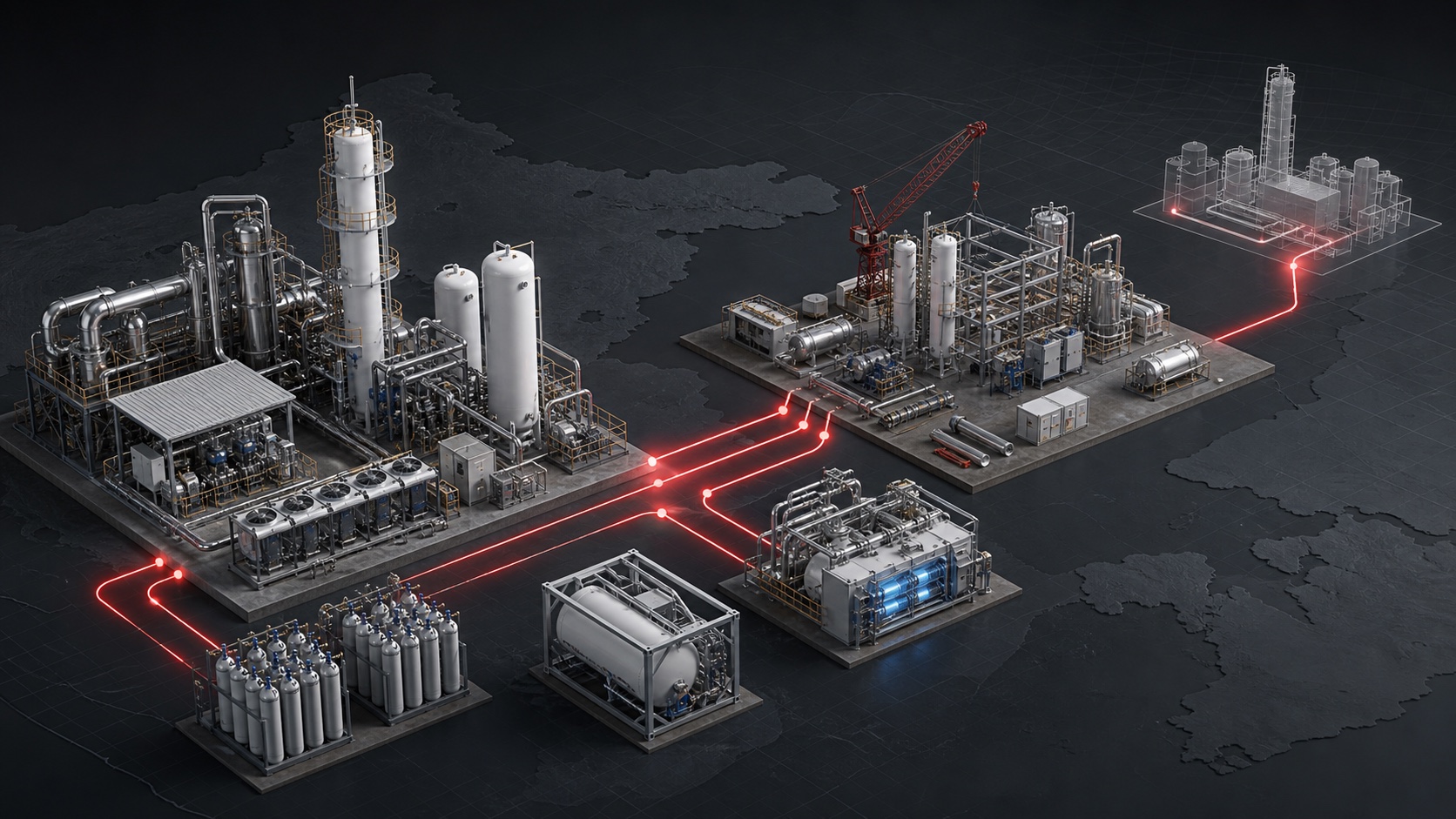
China helium production in 2025: output, imports and utilization
Jovo Energy's 2025 annual report, citing Longzhong Information, records domestic helium output of about 905 tonnes, equivalent to 5.07 million Nm³. It also reports imports of about 4,913 tonnes, equivalent to 27.51 million Nm³, and total consumption of 32.58 million Nm³. Import dependence was 84.44%.
Another industry series places 2025 nameplate capacity at about 14.66 million Nm³ and actual output at 4.63 million Nm³. Taken together, the public figures imply a nameplate utilization rate of roughly 31% to 35%. Differences between the series can arise from sample coverage, operating hours and whether crude-helium and purification assets are counted separately.
| 2025 measure | Published range | Interpretation |
|---|---|---|
| Nameplate capacity | 14.44 to 15.00 million Nm³/year | Compiled engineering capacity |
| Domestic output | 4.63 to 5.07 million Nm³ | Qualified annual production |
| Imports | 27.51 to 29.59 million Nm³ | Volume varies by conversion and reporting series |
| Total consumption | About 32.58 million Nm³ | Jovo annual-report industry series |
| Import dependence | About 84% to 85% | Imports remained the main source of supply |
China helium capacity in 2026: commissioned projects and estimates
The confirmed additions through August were modest relative to the existing base. Two projects have clear public evidence of commissioning or trial production.
| Project | Route | Published capacity | Status |
|---|---|---|---|
| Yanchang Petroleum, Jingbian | LNG storage BOG recovery | 0.128 million Nm³/year | Produced 99.999% helium during April commissioning |
| CNOOC Gas & Power, Yanchi | LNG BOG recovery and liquefaction | 0.20 million Nm³/year gas helium, or 55 tonnes/year liquid helium | Trial production and product shipment reported in April |
The published gas-helium and liquid-helium figures describe alternative product modes that use the same feed resource. Treating both as simultaneous output would double count capacity.
Including completed post-2025 projects, updated company figures and centralized crude-helium processing, the source compilation places all-route facility capacity at about 15.0 to 15.3 million Nm³ per year by August 2026. The comparable primary-extraction estimate is about 14.0 to 14.5 million Nm³ per year.
Helium production projects shaping China's capacity pipeline
Four projects account for about 1.84 million Nm³ per year of visible late-2026 capacity. Their contribution to calendar-year output will be much smaller if commissioning occurs in the fourth quarter.
| Project | Compiled design capacity | Latest public signal | Evidence treatment |
|---|---|---|---|
| JinHong Gas and Jingteng Energy, Alar | 0.76 million Nm³/year | Company expected trial production in the second half of 2026 | Under construction, not counted as operating supply |
| Shuifa Gas, Qingyang | 0.50 million Nm³/year | Company response points to completion around year-end 2026 | Capacity depends on commissioning and actual operation |
| Tongliao Yingtong Energy | About 0.30 million Nm³/year | Construction was reported near completion, but no commercial start was confirmed | Track first qualified product and shipment |
| Chongqing Kehe, Otog Front Banner | About 0.28 million Nm³/year | Core equipment was reported on site | Equipment delivery is not commercial production |
If most of this capacity is commissioned by year-end, the compiled base case reaches 16.8 to 17.2 million Nm³ per year. A separate industry forecast of roughly 30.58 million Nm³ depends mainly on a reported 14 million Nm³ project in Shaanxi. Public information available for this review did not identify a project owner, complete engineering scope or formal commissioning notice. The article therefore treats that figure as a conditional high case, not current capacity.
China helium capacity outlook for 2027
Shanxi Wanshengyuan's project notice provides the clearest quantified 2027 addition. Zefengda phase two is designed for 0.37 million Nm³ per year of helium and is scheduled for completion in May 2027. Phase one has reported capacity of 0.198 million Nm³ per year.
Other projects in Ningxian, Ordos, Baotou and Dazhou remain part of the reserve pipeline, but several lack a confirmed helium capacity or commissioning month. They should not be assigned to 2027 supply until the owner reports a defined plant scope and operating milestone.
| Scenario | 2027 year-end nameplate capacity | Main assumptions | Reading |
|---|---|---|---|
| Conservative | 17 to 18 million Nm³/year | Several late-2026 projects slip; only clearly disclosed additions progress | Imports remain dominant |
| Base case | 18 to 20 million Nm³/year | Most visible projects commission and Zefengda phase two proceeds | Domestic share rises, but output still depends on utilization |
| Conditional high case | 31 to 33 million Nm³/year | The unverified large Shaanxi project reaches commissioning | Do not use as confirmed capacity without owner disclosure |
These are scenario ranges compiled for planning, not company guidance or an official national forecast. Commissioning dates, feed-gas availability and operating rates can change the result materially.
Why helium production remains below nameplate capacity
Most domestic projects recover helium from a wider natural-gas or LNG process. Their helium output depends on the volume and helium concentration of the feed gas, the load of the host LNG plant, recovery efficiency and the stability of purification equipment.
Commercial conditions matter too. A technically available plant may reduce load when imported helium is cheaper on a comparable delivered basis. A plant may also have gas available but lack purification slots, liquid-helium containers, customer approval or a suitable package for the intended market.
- Feed gas: confirm flow, helium concentration and seasonal continuity.
- Host-plant load: BOG recovery falls when the LNG operation runs below plan.
- Processing chain: crude-helium recovery, purification and liquefaction must be matched.
- Qualification: 5N or 6N capability does not create immediate qualified sales.
- Logistics: cylinder bundles, tube trailers, dewars and ISO containers can constrain delivery.
- Economics: actual utilization responds to domestic operating cost and comparable import cost.
China helium production costs: the RMB 60/Nm³ model
For scenario planning, this article uses a domestic full-cost range of RMB 50 to 70/Nm³ and RMB 60/Nm³ as the midpoint. This is a cross-project model, not an audited cost for any individual plant. Feed-gas concentration, plant scale, host LNG load, recovery rate, depreciation and transport distance can move a project below or above that range.
The relevant comparison changes with the decision horizon. In the short term, an operating plant compares the risk-adjusted landed cost of imported helium with its domestic marginal cash cost. That cash cost includes feed, energy, consumables, labor, maintenance and incremental logistics. A new project must also recover depreciation and capital returns, so the long-term decision uses full cost.
Longzhong Information reported a 2025 average helium import price of USD 84.5/kg. A simplified conversion using 5.6 Nm³/kg and RMB 7.2 per US dollar gives about RMB 108.6/Nm³. This published average is a reference point, not a multiplier for estimating other import-price bands.
The model therefore uses direct price thresholds. A comparable import replacement price above RMB 110/Nm³ exceeds the RMB 70/Nm³ upper domestic cost benchmark by at least RMB 40/Nm³. That spread can provide a strong incentive for broad restarts and high operating rates. The published import average may combine liquid and gaseous helium, different purities, trade terms and packages, so plant-level comparisons still require the same product, delivery point, tax and payment terms.
| Comparable import-price condition | Domestic cost coverage | Potential utilization | Annualized domestic output | Expected market response |
|---|---|---|---|---|
| Below RMB 70/Nm³ | Lower-cost plants within the RMB 50 to 70/Nm³ model range | 25% to 32% | 4.25 to 5.45 million Nm³ | Only the lowest-cost and contracted domestic plants retain a clear operating case |
| RMB 70 to 80/Nm³ | Full model range, with up to RMB 10/Nm³ above the RMB 70 ceiling | 30% to 38% | 5.10 to 6.50 million Nm³ | Lower-cost domestic capacity runs; higher-cost plants begin to recover |
| RMB 80 to 90/Nm³ | Full model range, with RMB 10 to 20/Nm³ above the RMB 70 ceiling | 35% to 48% | 6.00 to 8.15 million Nm³ | More domestic plants can cover full cost and increase load |
| RMB 90 to 110/Nm³ | Full model range, with RMB 20 to 40/Nm³ above the RMB 70 ceiling | 45% to 60% | 7.65 to 10.20 million Nm³ | The price signal supports wider domestic operation, with a gradual response |
| Above RMB 110/Nm³ | Full model range, with at least RMB 40/Nm³ above the RMB 70 ceiling | 60% to 100% | 10.20 to 17.00 million Nm³ | Strong price incentive for broad restart and high-load operation, subject to physical availability |
Using RMB 108.6/Nm³ as the 2025 reference price places it in the RMB 90 to 110/Nm³ band. Price coverage alone would therefore support potential utilization of 45% to 60% in this model. Actual 2025 utilization was only about 31% to 35%, which shows that feed gas, host-plant load, processing, qualification and logistics prevented the full price incentive from converting into output.
The 60% to 100% range is a potential operating-rate scenario, not a claim that every plant will reach full load. It assumes that feed gas, host-plant schedules, recovery equipment, downstream purification, product qualification and logistics are available. If any of these constraints remain, actual utilization can stay below the price-driven level.
The output ranges are annualized against a year-end base capacity of 17 million Nm³. They are sensitivity cases, not a 2026 production forecast. New plants commissioned late in the year still need trial runs, qualification and ramp-up time.
When comparable import cost falls below the marginal cost of a domestic plant, that plant may reduce load or stop. When import purchase, shipping, exchange-rate or supply-risk costs rise, idle domestic plants can restart from lower cost to higher cost until domestic marginal supply approaches the import replacement cost. The adjustment is gradual because plant restarts, host LNG schedules, customer approval, contracts and liquid-helium container cycles all take time.
Import price mainly changes the utilization of installed capacity. Project construction changes nameplate capacity, while feed gas and equipment condition limit effective capacity. A high import price cannot raise domestic output beyond those physical limits, and a newly completed plant does not create immediate saleable supply if its operating economics are unfavorable.
What China helium capacity means for supply planning
For China helium sourcing, distinguish the upstream producer from the purifier, importer and distributor. The China helium suppliers map explains those roles; this article addresses production and capacity rather than supplier rankings.
China is adding domestic recovery and purification assets, but import dependence will not disappear on the current base-case project schedule. For procurement teams, a national nameplate figure is less useful than a verified delivery program tied to a specific plant, product form and container fleet.
Ask suppliers to identify the legal selling entity, source plant, current operating status, specification, representative certificate of analysis, available monthly volume, package, allocation terms and backup route. For semiconductor, medical, aerospace and low-temperature applications, verify the qualification status of the actual product and delivery chain.
Treat commissioning, qualified product, first shipment and stable commercial operation as four separate milestones. Only the last two provide strong evidence for near-term saleable supply.
Frequently asked questions
What is the difference between helium capacity and helium production?
Helium capacity is a design or sustainable operating rate, usually stated in Nm³ per year. Helium production is the actual output during a specified period. Compare figures with the same plant boundary and avoid counting the same helium at both recovery and purification stages.
What is China's helium production capacity in 2026?
The compiled all-route facility estimate is about 15.0 to 15.3 million Nm³ per year as of 31 August 2026. Estimated primary extraction capacity is about 14.0 to 14.5 million Nm³ per year after allowing for possible double counting.
How much helium did China produce in 2025?
Published industry figures place domestic output at about 4.63 to 5.07 million Nm³. Jovo Energy's annual report cites 5.07 million Nm³ of domestic output, 27.51 million Nm³ of imports and import dependence of 84.44%.
Why is China's helium output lower than its nameplate capacity?
Output depends on feed-gas helium concentration, LNG plant load, recovery rate, equipment uptime, downstream processing, qualification, logistics and market economics. Nameplate capacity is a design limit, not guaranteed supply.
What does the RMB 60/Nm³ helium cost assumption mean?
It is the midpoint of a RMB 50 to 70/Nm³ domestic full-cost range used for cross-project planning. The model does not use a fixed multiple to estimate import prices. A comparable import price above RMB 110/Nm³ exceeds the RMB 70/Nm³ upper cost benchmark by at least RMB 40/Nm³ and can support potential utilization of 60% to 100% when feed gas, equipment, qualification and logistics are available.
Will China be self-sufficient in helium by 2027?
Not under the base case. The compiled 2027 year-end range of 18 to 20 million Nm³ per year remains below projected domestic demand and actual output will be lower than nameplate capacity.
Does liquid-helium capacity add to gas-helium capacity?
Not when the figures describe alternative product modes using the same feed stream. In that case, adding gas and liquid capacity counts the same helium twice.
What should buyers track besides national capacity?
Track actual output, current saleable volume, purity, product form, qualification, plant load, container availability, allocation and backup supply.
Sources and methodology
This article was reviewed on 31 August 2026. Capacity totals were checked against corporate reports, company project notices, government-linked reporting and industry compilations. Where the owner had not confirmed commissioning, the project remained in the pipeline or conditional scenario.
- Jovo Energy 2025 annual report: domestic output, imports, consumption and import dependence.
- Longzhong Information 2025 helium import review: 4,912.8 tonnes of imports and an average import price of USD 84.5/kg.
- Ministry of Commerce price-monitoring information: national helium supply context and 2025 industry figures.
- Yanchang Petroleum Jingbian commissioning report: 0.128 million Nm³ per year and 99.999% trial product.
- China Energy News report on CNOOC Yanchi: trial production and gas or liquid product capacity.
- JinHong Gas 2026 half-year report: company disclosure and Xinjiang project context.
- Shuifa Gas 2025 annual report: operating and project background.
- Shanxi Wanshengyuan Zefengda phase-two notice: 0.37 million Nm³ per year and May 2027 target.
- Longzhong Information northwest helium survey: project pipeline and conditional high-capacity forecast.
- China Industrial Gases Industry Association: domestic liquid-helium and cryogenic-logistics development.
Project capacity is not a promise of output, availability or investment performance. Figures can change with design revisions, feed gas, commissioning, operating hours and statistical boundaries. Confirm live commercial availability with the relevant legal entity.
Need a current China helium supply review?
Share the application, destination, volume, purity, package and required date. We will help separate nameplate capacity from qualified, deliverable supply.
Discuss your requirement →