
Market & supply / Helium
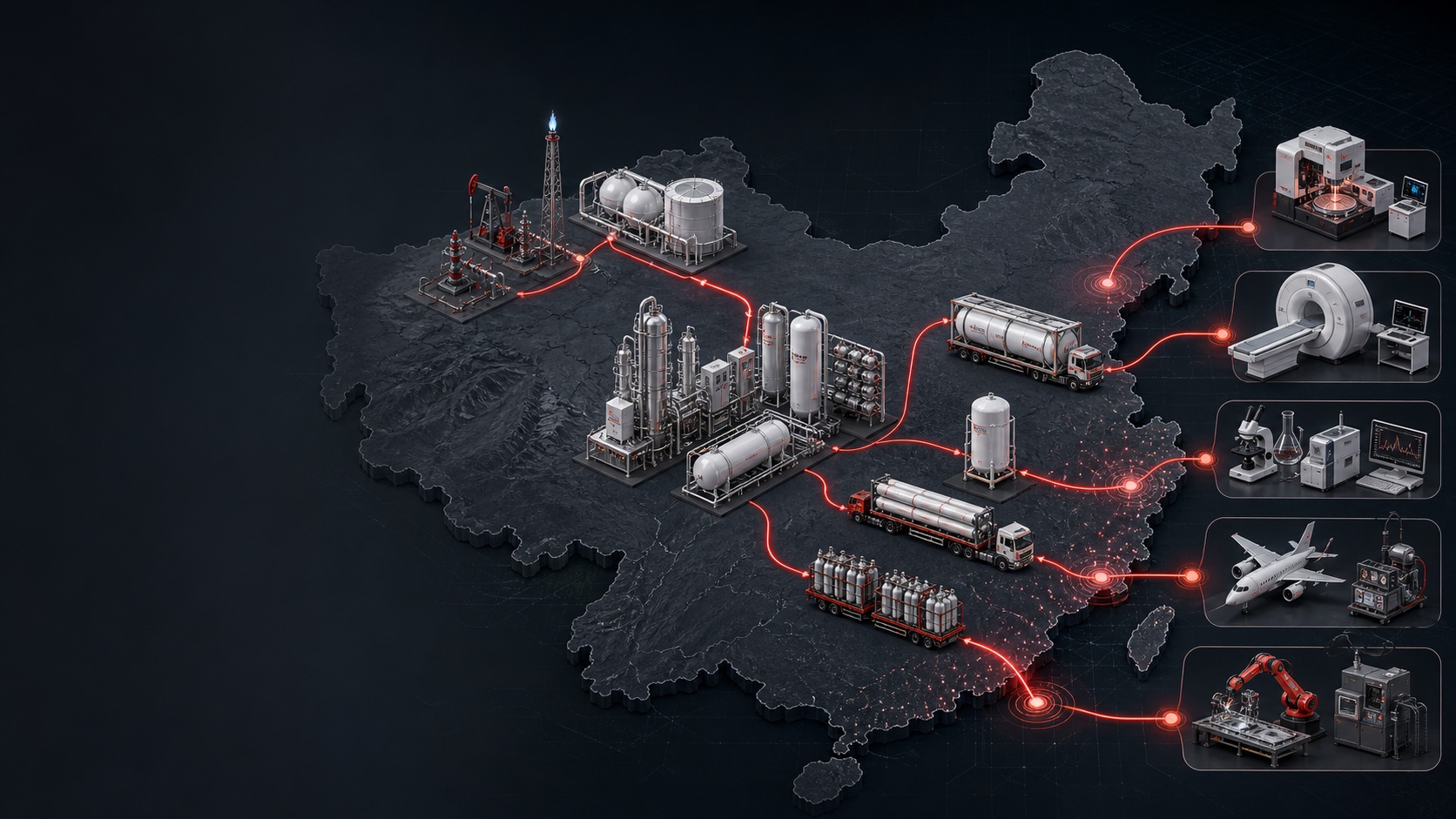
China Helium Suppliers Map 2026 Upstream Extraction to Downstream Distribution
A public-evidence map of China's LNG-BOG recovery projects, processing equipment, import logistics and downstream helium supply.
China's helium supplier landscape is a chain, not one market. Domestic recovery is increasingly visible around LNG boil-off gas projects in Inner Mongolia, Ningxia, Shanxi, Shaanxi and Sichuan; Xinjiang has also attracted announced project investment. Equipment makers enable concentration, purification and liquefaction, while imported liquid helium and industrial-gas distributors remain important to downstream supply. Project nameplate capacity is not the same as saleable volume, so buyers should verify operating status, current source, specification, package, route and continuity.
China helium supply in 2026: the context
The latest U.S. Geological Survey Mineral Commodity Summaries 2026 estimates China's 2025 helium production at about 3 million cubic metres, compared with roughly 190 million cubic metres globally. The same publication lists 1.1 billion cubic metres of identified helium resources in China. These estimates show why both domestic recovery projects and imported supply remain relevant; they do not identify individual supplier market shares.
China's publicly documented activity is concentrated in several different business models: recovering helium from natural gas or LNG boil-off gas (BOG), building cryogenic purification and liquefaction systems, importing and storing liquid helium, and supplying end users through dewars, ISO containers, tube trailers or cylinders. Treating every company in those layers as an interchangeable “helium producer” leads to poor sourcing decisions.
This article is a dated map of verifiable public evidence, not a complete supplier registry, a ranking, a market-share table or proof of current inventory. Project announcements and equipment demonstrations also do not automatically establish recurring commercial supply.
How LNG-BOG helium recovery works
Helium has an exceptionally low boiling point. During LNG production and storage, methane and other components are liquefied while helium remains in the gas phase and can become enriched in boil-off gas (BOG). That makes BOG a practical domestic feed stream, but not a finished helium product.
- 1. Stabilize the feed. Measure and condition BOG flow, pressure and composition; remove components that could freeze or damage downstream equipment.
- 2. Concentrate helium. Use cryogenic separation, membrane separation, pressure swing adsorption or a combination to reject methane, nitrogen and other bulk gases.
- 3. Remove trace impurities. Dehydrogenation, drying and final purification steps are selected for the feed and target specification.
- 4. Choose the product form. Purified gas can be compressed into tube trailers or cylinders; a liquefaction train is required for liquid helium.
- 5. Control storage and delivery. Cryogenic tanks, transfer equipment, containers and return logistics determine how much product reaches customers.
Cryogenic separation
Uses low-temperature phase behaviour to concentrate and purify helium. It can deliver high recovery, but requires demanding cold-box design and stable integration.
Membrane or PSA
Uses selective permeation or adsorption to remove bulk components. These methods can serve as concentration or polishing steps, depending on feed quality.
Hybrid process
Combines membrane, adsorption and cryogenic stages to balance recovery, energy use, product purity and optional liquefaction.
A 2025 technical review in Natural Gas Industry records multiple Chinese BOG helium projects and process routes. The supplied March 2026 research report was used to identify candidate projects; the entries published below were then checked against public government, company, exchange or research sources.
China helium supplier and project evidence map
| Publicly documented node | Location or scope | Value-chain role supported by the source |
|---|---|---|
| Xing Sheng + Sichuan Air Separation | Hangjin Banner, Inner Mongolia | The equipment provider records first product filling in August 2020 at a million-cubic-metre-class LNG flash-gas/BOG helium plant. The source supports a commissioning milestone and equipment role, not current available volume. |
| Yahay + Shudao Equipment | Etok Banner, Inner Mongolia | A listed-company investor record states that the LNG-BOG helium plant entered production in October 2023 and that product had been sold. Current output and allocation still require confirmation. |
| Shenran Zhongyuan + Fullcryo | Ningxia | Fullcryo documents a low-temperature BOG helium recovery and liquefaction demonstration, including extended operating hours. Ningxia's technology authority separately records engineering results for high-purity BOG helium recovery. |
| Youyan / GRINM equipment at a BOG project | Lüliang, Shanxi | A State-owned Assets Supervision and Administration Commission report documents a helium extraction unit operating at a local BOG project and identifies the equipment contributor. |
| CETC No. 16 Research Institute equipment | Yan'an, Shaanxi | CETC reports that its purification equipment produced ultra-pure helium at a natural-gas helium project in 2025. The evidence supports an equipment and project role. |
| Jiufeng Energy refined-helium project | Luzhou, Sichuan | The company's 2025 annual report says a 1-million-cubic-metre-per-year project was completed in 2025. This is company-reported nameplate capacity, not verified annual output. |
| JinHong Gas + Jingteng Energy | Alar, Xinjiang | A June 2025 company announcement records an investment agreement to establish a joint venture and develop gas and liquid helium recovery. It is mapped as announced/development, not operating supply. |
| Fullcryo | China / project-based | Public materials document BOG helium recovery, purification and liquefaction equipment at Ningxia and Inner Mongolia projects. |
| Hangyang | Hangzhou-based, China-wide activities | Public company updates describe helium sourcing, equipment, storage and transport, terminal applications and electronic-grade supply capabilities. |
| Hangyang liquid-helium import route | Hunchun, Jilin | A 2023 company announcement documents imported liquid helium arriving through Hunchun, illustrating a land-import and specialized-logistics node. |
| Air Liquide China | China operations | Its official China helium page presents packaged helium supply in cylinders and cylinder pallets for multiple applications. |
| Air Products China | China operations / global source network | Its official China page presents liquid and compressed helium with supply modes including ISO containers, dewars, tube trailers and cylinders. |
The table separates organizations, plants and logistics nodes because the evidence is not uniform. “Completed,” “commissioned,” “entered production,” “announced” and “available to buy” are different statuses. Publicly documenting one role or milestone does not prove every other role or continuing commercial supply.
Regional BOG helium project clusters
Domestic helium recovery is project-led and closely tied to natural-gas and LNG infrastructure. Regional activity should therefore be read as a set of host-plant, feedstock, equipment and operating relationships rather than a simple list of gas brands.
Inner Mongolia: the broadest publicly visible cluster
Sichuan Air Separation Group records first product filling in August 2020 from a million-cubic-metre-class helium plant using LNG flash gas at Xing Sheng in Hangjin Banner. The same project appears in the 2025 Natural Gas Industry review as an early domestic million-cubic-metre-class BOG installation.
For Etok Banner, a Shudao Equipment investor-relations record says the Yahay LNG-BOG helium plant officially entered production in October 2023 and had sold helium product. Fullcryo also identifies its core equipment role at Wanrui's Inner Mongolia BOG helium project. These disclosures establish separate project nodes; they do not provide a single comparable measure of current output.
Ningxia: recovery plus domestic liquefaction demonstration
Fullcryo's Shenran Zhongyuan case study documents a low-temperature BOG helium recovery and liquefaction train, reporting more than 10,000 cumulative operating hours at the date of publication. Separately, the Ningxia Department of Science and Technology records a 100,000-cubic-metre-per-year high-purity BOG helium demonstration result. The published figures are project-specific and should not be converted into a current regional supply total.
Shanxi and Shaanxi: equipment-led purification milestones
A SASAC project report describes Youyan/GRINM equipment operating at a Lüliang BOG helium project and producing stated 99.999% helium. In August 2025, CETC reported that No. 16 Research Institute equipment produced 6N9 ultra-pure helium at a Yan'an natural-gas helium project. Both are strong technology milestones, but neither page alone establishes current contracted sales volume.
Sichuan: new refined-helium capacity reported complete
Jiufeng Energy's 2025 annual report says its Luzhou 1-million-cubic-metre-per-year refined-helium project was completed in 2025 and raised company nameplate capacity to 1.5 million cubic metres per year. Those are company-reported capacity figures; actual production, product form and unallocated volume require direct confirmation.
Xinjiang: announced investment, not yet mapped as operating
In June 2025, JinHong Gas announced an agreement with Alar Jingteng Energy to establish a joint venture for gas and liquid helium recovery in Alar. Because the public item records an investment and development agreement, this map does not count the project as operating supply.
Equipment suppliers, liquefaction and logistics
Helium becomes commercially useful only after a demanding midstream chain. Depending on the feed and destination, that chain can include separation, purification, compression, liquefaction, cryogenic storage, transfill and returnable-container management. Equipment capability and gas ownership are separate questions.
Fullcryo
Fullcryo publicly presents helium recovery, refrigeration and liquefaction equipment. Its Ningxia and Inner Mongolia cases connect that equipment role to named BOG projects. Confirm plant ownership and gas availability separately.
Sichuan Air Separation & Shudao
Sichuan Air Separation documents the Xing Sheng plant's process equipment and commissioning milestone. Shudao's exchange filing links its equipment and operating investment to the Yahay project. These are distinct contracting and operating roles.
Hangyang
Hangyang's 2025 update describes source development, equipment, storage, transport and downstream application capabilities across its helium business.
Specialized logistics remain essential even as domestic recovery expands. Hangyang's 40-foot liquid-helium tank-container update illustrates the assets needed to move cryogenic product. A separate November 2023 announcement records imported liquid helium arriving through Hunchun in Jilin. These are capability and route examples, not a live 2026 shipment schedule.
3. Downstream distribution: match the supplier to the delivery mode
Downstream suppliers convert source access into a usable delivery program. The right supplier depends on whether the site needs liquid helium, high-pressure compressed gas, cylinder pallets, tube-trailer delivery, ISO-container volumes or a managed returnable-package cycle.
Integrated international gas suppliers
Air Liquide China publicly offers helium in cylinders and cylinder pallets and identifies uses across healthcare, electronics, laboratories and manufacturing. Air Products China presents both liquid and compressed helium and lists ISO containers, tube trailers, dewars and cylinders among its supply options. These pages establish product and format capabilities, not destination-specific availability or commercial terms.
Domestic integrated supply
Hangyang's public updates describe a broader helium chain spanning source channels, cryogenic equipment, transport and terminal supply. For buyers, the practical question is not whether a company appears on a supplier list, but whether its current operating route can support the exact location, volume, specification, package and delivery cadence.
Application determines the final controls
Semiconductor manufacturing, MRI service, laboratory analysis, leak testing and industrial processing can have very different impurity, continuity, documentation and interface requirements. A supplier that is suitable for one use is not automatically qualified for another.
How to shortlist a China helium supplier
- Define the supplier role. Do you need a gas producer, imported source, equipment contractor, logistics provider, packaged-gas distributor or an integrated program?
- Request the current source statement. Confirm whether the proposed supply is domestic, imported or blended across approved sources, and how source changes are controlled.
- Verify product evidence. Review the controlled specification, relevant impurity limits, certificate of analysis format, traceability and sampling plan.
- Confirm physical delivery. Match volume to liquid or compressed form, package size, connection, working pressure, on-site storage and return cycle.
- Test route feasibility. Check dangerous-goods requirements, cryogenic handling, destination access, lead time, container positioning and reverse logistics.
- Ask for continuity controls. Identify backup source, allocation rules, buffer strategy, maintenance exposure and the response to transport disruption.
- Separate nameplate capacity from output. Ask for current feed rate and helium concentration, recovery, uptime, saleable product form and unallocated volume—not only design capacity.
- Separate capability from availability. A website, project award, completion notice or equipment milestone does not prove that product is available for the requested date and destination.
- Run application qualification. The buyer remains responsible for accepting the gas, package and documentation for the intended process and market.
Frequently asked questions
What is LNG-BOG helium recovery?
LNG boil-off gas can concentrate helium that was present in the original natural gas because helium remains gaseous at LNG temperatures. A recovery train conditions the BOG, separates and concentrates helium, removes impurities, purifies the product and may liquefy it.
Does nameplate helium capacity equal available supply?
No. Actual output depends on feed composition and flow, recovery rate, uptime, maintenance, product form and commercial allocation. A buyer must verify current saleable volume separately.
Does China produce helium domestically?
Yes. Public sources document domestic production and extraction or purification projects in several regions. China also remains connected to imported helium and international supply networks.
Who are the largest helium suppliers in China in 2026?
No single current public primary source provides a complete, audited ranking across upstream production, equipment, imports and downstream distribution. Choose by required role, live availability and verified documentation rather than an unsupported league table.
Is a helium equipment manufacturer also a helium gas supplier?
Not necessarily. Equipment manufacture, plant operation, gas ownership, logistics and packaged-gas distribution are distinct roles. Some companies integrate several roles; verify the exact contracting entity and supply scope.
What should a buyer verify before choosing a China helium supplier?
Verify the supplier's role, current source and availability, product specification, batch analysis, package and interface, transport route, returnable-container terms, lead time, contingency plan and destination requirements.
Does this map prove that a supplier has stock today?
No. The map records public evidence available by 10 August 2026. Buyers must obtain a current quotation and written confirmation for product, quantity, package, delivery date and destination.
Primary sources and update policy
This map was reviewed on 10 August 2026. A Chinese-language BOG helium research report dated 29 March 2026 and supplied by the site owner was used as a discovery index. Published project claims were then checked against the public sources below. Secondary forecasts, unverified capacity totals and unsupported customer claims from the report were not carried into this article.
- USGS, Mineral Commodity Summaries 2026 — global production and resource context.
- Natural Gas Industry, 2025 technical review — BOG helium process routes and documented Chinese project milestones.
- Sichuan Air Separation Group — Xing Sheng million-cubic-metre-class plant and 2020 filling milestone.
- Shudao Equipment investor-relations record — Yahay production and sales status disclosed in 2024.
- Fullcryo, Shenran Zhongyuan case — BOG recovery and liquid-helium demonstration in Ningxia.
- Ningxia Department of Science and Technology — BOG helium extraction project result.
- SASAC — Lüliang BOG helium equipment project.
- CETC — Yan'an helium purification equipment update.
- Jiufeng Energy 2025 annual report — Luzhou project completion and company-reported nameplate capacity.
- JinHong Gas — 2025 Alar investment and project-development announcement.
- Hangyang — 2025 helium business update.
- Hangyang — liquid-helium tank-container capability.
- Hangyang — Hunchun import-route example.
- Air Liquide China — packaged helium formats and applications.
- Air Products China — helium forms and supply modes.
All availability, specifications, source routes, capacities and commercial terms must be confirmed directly with the relevant supplier. Inclusion does not constitute endorsement; omission does not mean a company lacks capability.
Need to map a helium requirement?
Share the application, destination, monthly volume, delivery mode, required specification and target date. Current supply must be confirmed for each request.
Discuss your requirement →