
Product guide / Disposable helium
Disposable helium tank buying guide
A practical sourcing framework for importers, distributors, retailers and private-label buyers.
Choose a disposable helium tank by working through six checks: local demand, verified balloon yield, pack contents, destination documents, transport route and landed cost. Compare every supplier on the same written specification. Do not select a tank from its unit price, litre model or headline balloon count alone.
Define the product before requesting prices
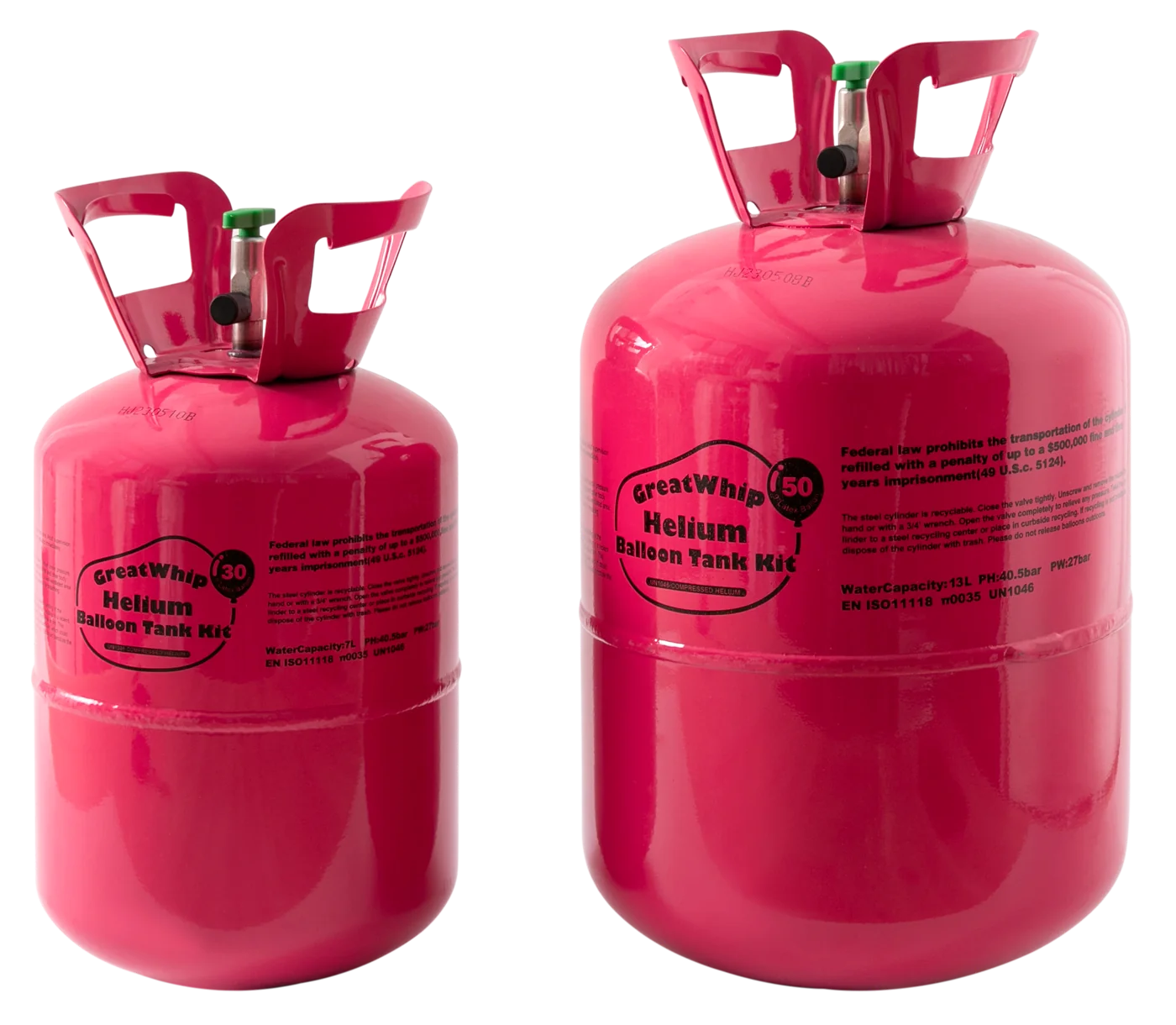
A disposable helium tank is a portable, non-refillable compressed-gas cylinder intended for balloon inflation. A retail kit may include the filled cylinder, inflation nozzle, printed carton, balloons, ribbon and instructions. Suppliers also sell tank-only formats, so a product name such as "50-balloon kit" is not a complete purchasing specification.
Write down the intended customer, destination country, sales channel, balloon type and planned order size first. A party-store kit, an online retail pack and a private-label supermarket program can use the same cylinder format but require different cartons, languages, barcodes, accessories and delivery plans.
The word "disposable" describes the cylinder's intended refill status. It does not remove dangerous-goods transport requirements or determine how the empty cylinder must be recycled. A cylinder marked non-refillable must not be refilled or modified. In the United States, 49 CFR 178.65 is the specification for DOT-39 non-reusable cylinders; other destinations may use different pressure-receptacle requirements.
Choose warehouse stock or private-label production
The purchase route changes the minimum order, branding work, lead time and amount of validation required. Stock is usually the practical route for a market test or smaller replenishment. OEM production is intended for buyers building their own branded range.
| Decision | Overseas brand stock | OEM / private label |
|---|---|---|
| Best fit | Market tests and smaller replenishment orders | Own-brand retail programs with forecast volume |
| Lesoo minimum | One pallet, subject to warehouse availability | One full container |
| Branding | Available GreatWhip or Gas Club stock | Approved tank color, artwork and retail packaging |
| Timing | Based on current destination stock and local delivery | Four weeks of production after deposit, plus transit |
| Main checks | Available models, retail packaging, lot identity and delivery terms | Product specification, artwork, sample, compliance review, inspection and shipping plan |
These are Lesoo's current commercial terms, reviewed on 17 September 2026, not industry-wide rules. Availability and order-specific terms must be confirmed in the quotation.
Compare balloon yield on the same basis
The litre model, gas filling specification, claimed balloon count and accessories answer different questions. Lesoo currently lists 7L, 13L and 22L models with label capacities of 30, 50 and 90 standard 9-inch latex balloons. Each listed retail kit includes 30 balloons and ribbon. The label capacity is not the accessory count.
Use the helium tank size guide for the carton dimensions, gross weights and distributor stock-mix discussion. For a buying comparison, ask each supplier to complete the same fields below.
| Comparison field | What to request | Why it matters |
|---|---|---|
| Model identity | Tank model, cylinder specification, label version and SKU | Prevents a sample or certificate from being applied to a different product |
| Filling specification | Gas composition or grade and the approved filling specification | Defines what is supplied rather than relying on the product name |
| Yield basis | Balloon material, inflated diameter, inflation method and test conditions | Makes balloon-count claims comparable |
| Pack contents | Tank, nozzle, balloons, ribbon, instructions and carton | Separates tank capacity from the retail bundle |
| Logistics data | Carton dimensions, gross weight, pallet plan and container quantity | Supports freight, storage and handling calculations |
Retail yield claims should be treated as model-specific guidance, not as a universal conversion. GasClub's current comparison lists its 7L, 13L and 22L tanks at up to 20, 50 and 100 balloons. Those figures describe the GasClub range. A wholesale buyer should still ask for the balloon material, inflated diameter and test method before comparing them with another supplier's stated yield.
Test the exact sample you intend to sell
A showroom sample is useful only when it represents the proposed order. Record its SKU, cylinder marks, filling information, valve, label and packaging version. If the production item will differ, list every approved change in writing.
- Confirm identity. Match the tank, valve, nozzle, carton and instructions to the quotation and sample record.
- Inspect the retail pack. Check print quality, languages, barcode placement, required warnings, accessories and protection around the valve.
- Run a controlled yield check. Use the balloon material and inflated diameter intended for retail. Follow the supplied instructions and record completed balloons, failed balloons and unused gas.
- Check operation. Assess the valve and nozzle for clear use, secure shutoff and instructions that a first-time customer can follow.
- Keep evidence. Photograph the sample and retain the approved artwork, results and version number with the purchasing file.
Buyers should review the manufacturer's test evidence and use qualified inspection providers where required. Do not modify, refill, heat, puncture or pressure-test a retail cylinder outside an approved procedure.
Check documents against the destination and route
There is no single certificate that approves a disposable helium tank for every market. The cylinder, filling, consumer pack, workplace information and transport movement can be governed by different requirements. Ask which document applies to which product model, lot, country and shipment.
- An approved product and packing specification that names the model, filling, valve, accessories, carton, dimensions and gross weight.
- A current Safety Data Sheet for the supplied gas product, with supplier identity and transport information.
- Evidence for the pressure-receptacle specification, approvals, markings and tests required at the destination.
- The proper shipping name, UN number, hazard division, marks, labels and shipping documents for the selected route.
- Agreed production and final-inspection records linked to the order or lot.
- Approved consumer label, instructions, languages, barcode and private-label artwork.
- A dangerous-goods booking and delivery plan accepted by qualified logistics providers.
Why a non-flammable gas still needs transport planning
The UN dangerous-goods list identifies compressed helium as UN1046, Division 2.2. The classification is non-flammable, non-toxic gas, but the package still contains gas under pressure. The UNECE Model Regulations, Revision 24, cover classification, packaging, testing, marking, labelling and documentation at model-rule level.
For a U.S. shipment, 49 CFR 173.301 sets general cylinder requirements for Class 2 materials offered for transport. For packaged sea freight, the IMO explains that the IMDG Code governs dangerous goods carried in packaged form. The current route, carrier and destination rules must be reviewed before the order is released.
For U.S. workplaces, OSHA's Hazard Communication Standard requires hazard information through labels, Safety Data Sheets and worker information. Buyers in other markets should map the equivalent local requirements rather than treating a U.S. SDS or cylinder mark as automatic global approval.
Compare landed cost, not an isolated tank price
Normalize quotations to the same Incoterm, product specification, pack contents, loading method and destination. A low unit price can be offset by a larger carton, lower verified yield, dangerous-goods surcharges, extra artwork work or slow-moving stock.
Landed cost per saleable kit should include the product, packaging and artwork charges, dangerous-goods transport, freight and insurance, import charges, customs handling, inland delivery and the expected cost of damaged or rejected units. State separately which taxes are recoverable in your market.
For an additional retail comparison, divide landed cost per saleable kit by the verified balloon yield. Use this only when the suppliers were tested with the same balloon material, diameter and inflation method. Otherwise the calculation produces a precise-looking number from incompatible claims.
| Quote item | Normalize before comparing | Common omission |
|---|---|---|
| Product | Same model, filling specification, valve and kit contents | Comparing tank-only and full-kit prices |
| Packaging | Same carton, language set, barcode and artwork scope | Plate, sample or artwork revision charges |
| Loading | Palletized or floor-loaded, with quantities by size | Loss of container capacity after palletization |
| Freight | Same Incoterm, destination and dangerous-goods basis | Local port, brokerage and final-mile charges |
| Quality | Same sample, inspection scope and acceptance criteria | Rework, rejection and replacement exposure |
Use a controlled wholesale order process
- Write the buying brief. Name the destination, channel, sizes, quantities, balloon basis, brand route and required arrival window.
- Shortlist matching offers. Remove quotes that do not identify the product, pack, delivery basis or required documents.
- Review documents early. Check pressure-receptacle, transport, label and SDS requirements before approving artwork or paying for production.
- Approve the sample and test basis. Keep a signed or otherwise controlled record of the product and packaging version.
- Normalize the commercial comparison. Use landed cost and verified yield, not headline unit price.
- Lock the order specification. Attach the approved artwork, packing list, inspection criteria and shipping terms to the purchase order.
- Inspect and release. Review the agreed production evidence and final inspection before shipment.
- Plan receipt and after-sales support. Prepare safe storage, staff information, damage handling and a customer response process.
For Lesoo OEM orders, the current stated production period is four weeks after receipt of deposit. Transit time is additional and depends on destination and route. Confirm both dates in the order-specific schedule.
Avoid these purchasing mistakes
- Comparing balloon counts without matching balloon size, material and inflation method.
- Treating the litre model as the usable gas quantity or expected yield.
- Assuming every kit contains the same number of balloons as the label capacity.
- Accepting a certificate without matching its holder, product model, mark, destination and validity.
- Approving attractive artwork before checking mandatory label and language requirements.
- Comparing EXW, FOB and delivered prices as if they covered the same costs.
- Booking ordinary parcel or freight service without disclosing the compressed-gas shipment.
- Buying an equal mix of sizes without retailer demand or a documented trial plan.
Disposable helium tank buyer FAQ
What size disposable helium tank should I buy?
Choose the size from verified demand, the balloon material and inflated diameter, the tested yield, carton dimensions and gross weight. The tank's litre model alone does not establish balloon yield or commercial fit.
How should wholesale buyers compare balloon-count claims?
Compare claims based on the same balloon material, inflated diameter and test method. Ask for the filling specification and test basis, then check a sample with the balloons intended for retail.
Which documents should a disposable helium tank supplier provide?
Request an order-specific product and packing specification, a current SDS, the transport classification and shipping information, evidence for the pressure-receptacle requirements applicable at the destination, agreed inspection records and approved label artwork.
Are disposable helium tanks dangerous goods for shipping?
Compressed helium is listed as UN1046, Division 2.2. The package, marks, labels, documents, carrier acceptance and route must comply with the rules that apply to the destination and transport mode.
Can a disposable helium tank be refilled?
A cylinder marked non-refillable must not be refilled or modified. Follow the supplier's emptying and disposal instructions together with local waste and recycling rules.
Should I buy warehouse stock or order private-label tanks?
Warehouse stock suits market testing and smaller replenishment orders. Private-label production suits buyers who can support their own artwork, approvals and a full production order. Lesoo's current minimum is one pallet for available overseas stock and one full container for OEM production.
Sources and review scope
Product and commercial details were reviewed on 17 September 2026. Regulations and carrier acceptance can change, so buyers should confirm the rules and documents for the exact order, destination and transport route.
- Lesoo disposable helium tanks: current range, pack contents, minimum orders, production period and loading information.
- Lesoo disposable helium specifications (PDF): purchasing reference for listed models and packing data.
- Helium Tank Sizes for Distributors: model comparison, yield basis and stock-mix guidance.
- UNECE UN Model Regulations, Revision 24 (2025): current model framework for dangerous-goods classification, packaging and communication.
- 49 CFR 172.101, 49 CFR 173.301 and 49 CFR 178.65: U.S. transport listing, general cylinder requirements and DOT-39 specification.
- International Maritime Organization, IMDG Code overview: dangerous goods carried by sea in packaged form.
- OSHA Hazard Communication Standard: U.S. workplace labels, Safety Data Sheets and information duties.
- GasClub tank comparison: current retail example listing 7L, 13L and 22L tanks at up to 20, 50 and 100 balloons. The figures are specific to the GasClub range.
Related purchasing resources
Prepare a comparable quotation
Send your destination, sales channel, tank sizes, quantities and brand route. Include the balloon basis and required delivery date so the product and logistics can be reviewed together.
Request a disposable helium quotation